What Is Open Source Software? (With Real Examples)
Open source software is everywhere, from the phone in your pocket to the servers running the internet, but most people have only a vague idea of what "open source" actually means or why it matters.
The basic definition, without the jargon
Open source software is software whose source code is made publicly available. Anyone can read it, modify it, and distribute their own version, subject to the terms of whatever license the project uses. That's the short version.
The longer version matters too. The Open Source Initiative, which has maintained the official definition since 1998, lists ten criteria a license must meet to qualify as truly open source. A few of the most important: the license can't restrict who uses the software or what field they work in, and derivative works must be allowed under the same terms. So "source available" (where a company posts its code but restricts what you can do with it) is technically not the same thing as open source, even though marketers often blur that line.
The opposite is proprietary or closed source software. With proprietary software, you get a compiled binary that runs on your machine, but the underlying code is a trade secret. Microsoft Windows, Adobe Photoshop, and Apple's macOS are classic examples of that model.
Real open source software examples you've probably used
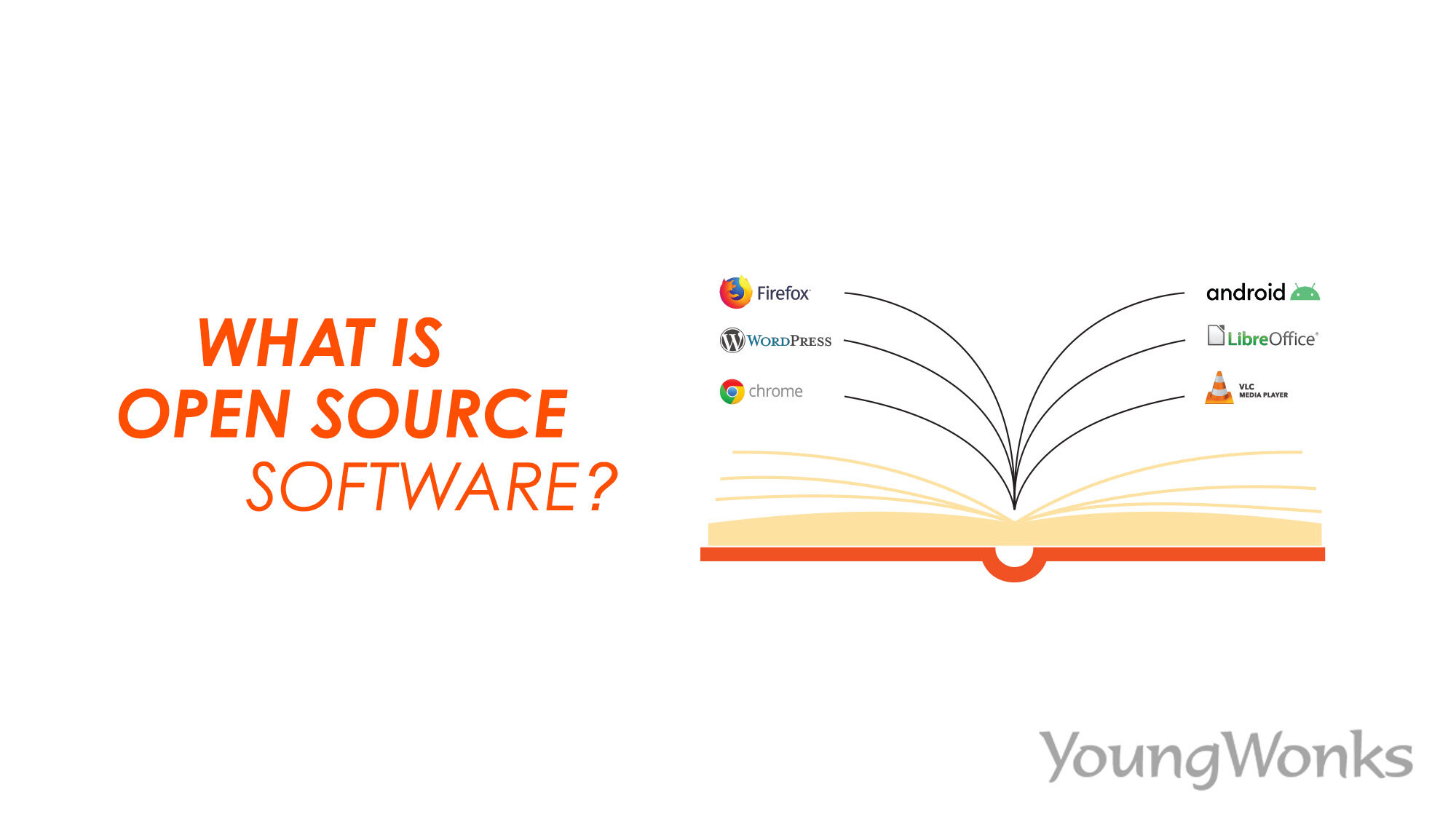
This is where the concept becomes concrete. Open source isn't a niche curiosity. It's the default infrastructure of modern computing.
Linux
The Linux kernel is the most consequential piece of open source software in existence. First released by Linus Torvalds in 1991, it now runs on Android phones, cloud servers, supercomputers, and embedded devices. According to the Linux Foundation, the kernel has received contributions from over 20,000 individual developers across more than 1,700 companies since tracking began. Every line of that code is readable by anyone on earth.
Firefox
Mozilla Firefox is an open source web browser. Its source code lives on Mozilla's servers and anyone can compile their own build. The Tor Browser, which strips away tracking features and routes traffic through the Tor network, is built directly on Firefox's codebase. That's exactly what open source enables: someone takes an existing project, modifies it for a specific purpose, and ships it to a different audience.
VLC media player
VLC is a free, open source media player that handles practically every video and audio format without requiring additional codecs. It's been downloaded over 3 billion times. Most people have no idea it's open source because it just works, which is actually the whole point.
LibreOffice
LibreOffice is a full office suite (word processor, spreadsheet, presentation software) that competes directly with Microsoft Office. It started as a fork of OpenOffice.org after Oracle acquired Sun Microsystems and the community grew concerned about the project's direction. The fork happened in 2010 and LibreOffice has been the more actively developed branch ever since.
WordPress
About 43% of all websites on the internet run on WordPress, according to W3Techs. It's open source, released under the GPL license. The commercial ecosystem built around it (themes, plugins, managed hosting) is worth billions of dollars annually. That commercial success sitting on top of free, open code is not a contradiction. It's a well-worn business model.
Android
Android is based on the Linux kernel and is technically open source through the Android Open Source Project (AOSP). The version you get on most phones has Google's proprietary apps layered on top, but the core OS is available for anyone to compile and modify. That's why phones like Fairphone can run a completely Google-free Android build.
Open source software in operating systems specifically
If you're looking for open source examples in operating systems, the answer starts and ends with Linux. But there's more to it than just "Linux."
A Linux distribution (distro) is a complete operating system assembled around the Linux kernel. Ubuntu, Fedora, Debian, Arch Linux: all open source, all free to use and modify. If you want to understand how they compare for everyday use, there's a solid breakdown of the best Linux distros for beginners that covers what actually matters for new users.
FreeBSD is another open source operating system, though it's based on the BSD Unix lineage rather than Linux. It powers parts of PlayStation consoles and Netflix's content delivery infrastructure. OpenBSD, a FreeBSD relative, is used heavily in security-critical environments.
What are the four open source software categories?
This question comes up a lot. There's no universally agreed-upon list of exactly four categories, but a practical breakdown often looks like this:
- Operating systems: Linux distributions, FreeBSD, Android (AOSP)
- Applications: Firefox, LibreOffice, GIMP (image editor), VLC, Audacity
- Development tools: Git, GCC (GNU Compiler Collection), Python, the Apache web server
- Libraries and frameworks: OpenSSL, React (frontend JavaScript), TensorFlow (machine learning)
Some sources frame those four as operating systems, programming languages, databases, and applications. Either way, the point is that open source software exists across every layer of the software stack, not just at the user-facing application level.
What's the most popular open source software?
By sheer install base, Android wins. Billions of active devices. But if you're counting by developer impact, Git is probably the right answer. Git is a version control system created by Linus Torvalds in 2005, and it's now used by essentially every professional software project on the planet. GitHub, GitLab, and Bitbucket are all built around it.
The Apache HTTP Server ran more of the web for longer than anything else. At its peak it powered over 60% of all websites. It's been gradually losing share to Nginx (also open source), but Apache has been running continuously since 1995.
Among databases, MySQL and PostgreSQL dominate different corners of the market. MySQL runs under much of the legacy web (a huge portion of WordPress installs use it). PostgreSQL is often the choice for newer, more complex applications because of its feature set and standards compliance.
Is ChatGPT open source software?
No. ChatGPT is not open source. OpenAI publishes some research papers and has released certain tools, but the model weights for GPT-4 and later versions are proprietary. You can't download the model, inspect it, modify it, or redistribute it. The name "OpenAI" is famously misleading on this point.
There are legitimately open source large language models. Meta's LLaMA 2 and LLaMA 3 models were released with weights available for download, which puts them closer to open source, though some researchers argue the license restrictions still don't meet the full Open Source Initiative definition. Mistral AI has released several models under the Apache 2.0 license, which is a proper open source license. The distinction matters because a genuinely open model can be audited for bias, fine-tuned for specific use cases, and run on your own hardware without sending data to a third party.
Advantages of open source software
The case for open source isn't just ideological. There are practical, concrete reasons why organizations and individuals choose it.
Cost. The software itself is free. A startup can run its entire backend on Linux, PostgreSQL, and Nginx for zero licensing fees. Compare that to a Windows Server license, which can run several thousand dollars per server.
Security transparency. The common argument is that "many eyes" catch bugs faster. This is partially true and partially overstated. What is definitely true is that security researchers can audit open source code independently, without trusting a vendor's claims. The OpenSSL Heartbleed vulnerability from 2014 was severe precisely because so much infrastructure depended on it, but it was also found and fixed by the community rather than being quietly patched with no explanation.
No vendor lock-in. If the company behind a proprietary tool shuts down or changes pricing, you're stuck. With open source, you can fork the project, hire developers to maintain your own version, or migrate to an alternative. You own your stack in a way you simply don't with closed source software.
Customization. This matters enormously at scale. Amazon, Google, and Meta all run heavily modified versions of the Linux kernel tuned to their specific hardware. A company running MySQL can patch the database engine to fix a performance issue specific to their query patterns without waiting for Oracle to prioritize it.
The community around these projects is also a resource. Sites like It's FOSS have built extensive libraries of practical guides specifically because open source software has an engaged user base that documents, explains, and teaches.
What are the downsides of open source?
Being honest about the problems is more useful than pretending open source is perfect.
Support. If something breaks in proprietary software, you call a support line. With open source, your options range from excellent (Red Hat Enterprise Linux comes with paid support contracts) to nonexistent (a two-person hobby project maintained in someone's spare time). The "free" price tag doesn't include anyone obligated to help you.
Maintenance burden. The open source ecosystem has a sustainability problem. A huge fraction of internet infrastructure depends on tiny libraries maintained by one or two unpaid volunteers. The Log4Shell vulnerability in late 2021 exposed this brutally: a critical flaw in log4j, a Java logging library that runs in thousands of enterprise applications, was being maintained by a handful of volunteers with no funding. The cost of fixing it was borne by the entire industry, not proportional to who benefited from the free code.
Fragmentation. Linux has hundreds of distributions. Some of that variety is useful. Some of it is chaos. New users often struggle to know which version of a tool to install, which distribution to trust, or whether a piece of software they need even runs on their chosen distro.
UX polish. Historically, open source desktop software has lagged behind commercial alternatives on interface design. GIMP is powerful but significantly harder to use than Photoshop. LibreOffice handles complex formatting less gracefully than Microsoft Word. This gap has narrowed considerably over the past decade, but it hasn't closed entirely.
For a fuller look at the structural problems in the ecosystem, the piece on the dark side of open source covers the real issues without softening them.
Is open source software free?
Free as in free beer, or free as in freedom? The open source community uses those two meanings deliberately because they're not the same thing.
Most open source software is available at no cost (free as in beer). But the core principle is about freedom (libre): the freedom to run, study, modify, and distribute. Red Hat sells subscriptions to its enterprise Linux product for substantial amounts of money, and the software is still open source. You're paying for support, certification, and integration work, not for the code itself.
Some open source projects also accept dual licensing. MySQL is available under both the GPL (open source) and a commercial license. If you want to include MySQL in a closed-source product without opening your own code, you pay Oracle for a commercial license. The code is the same either way.
So: yes, you can almost always get open source software for free. No, "open source" doesn't legally mean "must be free of charge forever." The two concepts overlap substantially but aren't identical.
Closed source software examples, for comparison
Understanding open source is cleaner when you have the contrast. Closed source (proprietary) software you're almost certainly using right now:
- Microsoft Windows and Microsoft Office
- macOS and iOS (Darwin, the underlying Unix layer, is open source, but the full OS is not)
- Adobe Photoshop, Illustrator, Premiere
- Slack (the desktop client has some open source components, but the core product and backend are proprietary)
- Most video games
- Zoom
None of that software is inherently bad. But when you use it, you're trusting the vendor's claims about security and privacy, you can't modify it, and if the vendor raises prices or discontinues the product, your options are limited.
Why this matters beyond the technical details
Open source software is infrastructure in the same way roads and electrical grids are infrastructure. You probably don't think about the Linux kernel when you watch a video on YouTube, but it's there, running on the server that delivered that video. Git is on every developer's machine. OpenSSL encrypts most of the sensitive data traveling across the internet.
The question of who maintains that infrastructure, who funds it, and who controls the licenses is genuinely important, in the same way the question of who maintains a city's water supply is important. The software is open, which is good. But open doesn't mean automatically maintained, funded, or secure. That tension is what makes open source one of the more interesting ongoing stories in technology.